Pompeii Graffiti Quotes and Translations: Ancient Roman Wall Messages
Affiliate Disclosure: This page contains affiliate links. If you book through these links, we may earn a commission at no additional cost to you. All recommendations are based on our research and editorial judgment.
Discover practical tips for your visit: visitor guide, tickets guide, and history of Pompeii.
Pompeii graffiti consists of thousands of ancient inscriptions scratched or painted onto walls, columns, shops, and homes. These messages include love notes, political slogans, insults, advertisements, and everyday remarks, giving visitors unusually direct evidence of Roman life before AD 79. This guide translates notable Pompeii graffiti quotes into English and explains what they reveal about daily Roman life.
Over 11,000 individual inscriptions have been documented across Pompeii's ruins. Unlike formal monuments or imperial statues erected by civic elites, these spontaneous scribblings preserve the authentic voices of ordinary shopkeepers, gladiators, enslaved workers, women, and travelers.
Contents
- Famous Pompeii Graffiti Quotes and English Translations
- What Did Pompeii Graffiti Say?
- Political Graffiti in Pompeii: Election Slogans and Campaign Messages
- Pompeii Bathroom Graffiti: What Was Written in Public Latrines?
- Pompeii Wall Writings: Where Can You See Them Today?
- What Languages Were Used in Pompeii Graffiti?
- What Does Pompeii Graffiti Reveal About Roman Life?
- Where to See Pompeii Graffiti on a Self-Guided Visit
- Why Is Pompeii Graffiti Difficult to Preserve?
- Frequently Asked Questions About Pompeii Graffiti
- Primary Sources and Epigraphic References
Famous Pompeii Graffiti Quotes and English Translations
The following table collects notable Pompeii graffiti quotes with their Latin or Greek originals, modern English translations, and historical context:
| Category | Inscription / Latin Quote | English Translation | Location on Site | What It Reveals |
|---|---|---|---|---|
| Love & Romance | Amantes, ut apes, vitam mellitam exigunt | "Lovers are like bees in that they live a honeyed life." | House of the Cryptoporticus | Idealized romantic expression and popular poetic sentiment. |
| Love Triangle | Successus the weaver (CIL IV 8259) | "Successus, a weaver, loves the innkeeper's slave girl named Iris. She, however, does not love him. Still, he begs her to have pity on him." | Tavern near Amphitheater (Regio I) | Working-class romantic rivalries and interactions within local taverns. |
| Romance | Methe, slave of Cominia (CIL IV 2457) | "Methe, slave of Cominia, from Atella, loves Chrestus. May Pompeian Venus be dear to them both and may they always live in harmony." | Theater corridor | Devotion among enslaved individuals invoking Venus Pompeiana for domestic harmony. |
| Political Slogan | Cuspius Pansa aedilis... (programmata) | "All the goldsmiths support Gaius Cuspius Pansa for public office." | Via dell'Abbondanza (Regio IX) | Trade guilds and artisanal collectives organizing municipal voter blocks. |
| Political Satire | Street parody inscription (programmata) | "The petty thieves support Vatia for public office." | Via dell'Abbondanza | Sarcastic counter-campaigning and biting Roman political humor. |
| Political Notice | Marcus Cerrinius Vatia endorsement | "I ask that you elect Marcus Cerrinius Vatia to public office. All the late drinkers support him." | Tavern facade, Via di Nola | Local hospitality establishments acting as hubs of grassroots campaigning. |
| Humor & Teasing | Epaphra pilicrepus non est (CIL IV 1904) | "Epaphra is not good at ball games." | Basilica exterior wall (Forum) | Casual public ribbing and informal leisure culture outside the law courts. |
| Insult | Street wall graffito (CIL IV 2360) | "Chie, I hope your hemorrhoids hurt so much that they burn worse than they ever have before!" | Street wall (Regio VII) | Creative vulgar cursing and personal grievances preserved in public plaster. |
| Personal Remark | Samius to Cornelius (CIL IV 1880) | "Samius to Cornelius: go hang yourself!" | Law court corridor, Basilica | Spontaneous hostility and banter recorded between named acquaintances. |
| Bodily Functions | Apollinaris medicus Titi... (CIL IV 5436) | "Apollinaris, the doctor of the emperor Titus, defecated well here." | Public latrine wall | Imperial court status humorously asserted in an everyday public sanitary space. |
| Commercial Ad | Bar of Asellina tariff notice | "Asellina's girls—Zmyrina, Maria, Aegle—cost 4 asses." | Thermopolium of Asellina | Clear price schedules for services posted directly outside commercial establishments. |
| Philosophical | Admiror, O paries... (CIL IV 2487) | "O walls, you have held up so much tedious graffiti that I am amazed you have not already collapsed in ruin." | Amphitheater exterior wall | Ancient self-awareness and meta-commentary on the sheer volume of public writing. |
| Daily Labor | Workplace tally inscription | "On April 19th, I made bread." | Bakery of Popidius Priscus | Routine workplace tracking and personal record keeping among daily laborers. |
What Did Pompeii Graffiti Say?
Pompeii's surviving inscriptions encompass nearly every dimension of daily Roman life, falling into several distinct communicative categories:
Love, Romance, and Heartbreak
The walls of Pompeii acted as an open forum for declarations of passion, unrequited love, and romantic disputes:
- Passionate declarations: "Let everyone in love come and see. I want to break Venus' ribs with clubs and deform her hips. If she can strike through my soft chest, then why can't I smash her head with a club?"
- Poetic greetings: "Health to you, Victoria, and wherever you are may you sneeze sweetly."
- Tavern drama: Heated dialogues between rivals scribbled sequentially across the same plaster surface, creating ancient message threads that mirrored modern social media debates.
Humor, Insults, and Social Banter
Romans took evident delight in witty burns, physical mockeries, and playful insults:
- "Stronius knows nothing!"
- "Phileros is a eunuch!"
- "Lucius painted this, he is a scoundrel."
Commercial Notices and Lost Property
Merchants and residents used exterior walls to advertise commodities, announce rewards, and record transactions:
- Lost and found: "A copper pot went missing from my shop. Anyone who returns it to me will be given 65 bronze coins. 20 more will be given for information leading to the capture of the thief."
- Hospitality notices: Wine tariffs, lodging availability, and stable accommodations for pack animals.
Political Graffiti in Pompeii: Election Slogans and Campaign Messages
Political graffiti in Pompeii, formally known as programmata, was painted in bold red or black letters along high-traffic thoroughfares such as Via dell'Abbondanza. These slogans endorsed candidates for annual municipal magistracies—the duoviri (chief magistrates) and aediles (officials overseeing public works, streets, and markets)—on behalf of trade guilds, neighborhood associations, and tavern patrons.
Unlike spontaneous scratched graffiti (graffiti proper), political programmata were professionally painted by scriptores (sign-writers) working at night with ladders and lanterns.
Notable features of Pompeian political graffiti include:
- Guild endorsements: Masons, bakers, fishermen, fullers, and goldsmiths publicly endorsed candidates who favored their economic interests (e.g., "The pack-carriers request the election of Lucius Ceius Secundus as aedile").
- Integrity slogans: Common endorsements used the abbreviation O.V.F. (oro vos faciatis—"I beg you to make him") followed by D.R.P. (dignum rei publicae—"worthy of the commonwealth").
- Satirical lampoons: Opponents occasionally commissioned parody slogans claiming backing from disreputable groups (e.g., "The runaway slaves and sneak-thieves support Vatia").
Pompeii Bathroom Graffiti: What Was Written in Public Latrines?
Pompeii bathroom graffiti was scratched into the plaster walls of public multi-seat latrines and bathhouse facilities throughout the city. These inscriptions ranged from practical bodily observations and medical humor to crude insults and personal status claims.
Roman public latrines were communal, unpartitioned spaces where citizens sat side by side, making them natural hubs for candid wall writing:
- Relief notices: Visitors frequently recorded their satisfaction after using the facilities, such as the famous inscription by Apollinaris, personal physician to Emperor Titus, commending his successful bowel movement.
- Philosophical reflections on mortality: Inscriptions near latrines frequently juxtaposed physical bodily reality with stoic reminders (e.g., "What is the use of riches? Eat, drink, and relieve yourself, for after death there is no pleasure").
- Warnings and practical advice: Reminders not to misuse public water basins or leave messes that could anger the protective deities of the latrine, such as the goddess Fortuna.
Pompeii Wall Writings: Where Can You See Them Today?
Visitors to the Pompeii Archaeological Park can observe original wall writings preserved in situ at several key locations, including the Basilica, the Lupanar, and Via dell'Abbondanza. While many delicate inscriptions were transferred to the National Archaeological Museum of Naples (MANN) or protected behind barriers, substantial traces remain visible on site.
When searching for wall writings during your visit, keep these practical points in mind:
- Look for dipinti vs. graffiti: Dipinti are painted inscriptions (often red or black electoral slogans and gladiator game announcements) on exterior building facades; graffiti are scratched directly into stucco with a stylus, fingernail, or small knife.
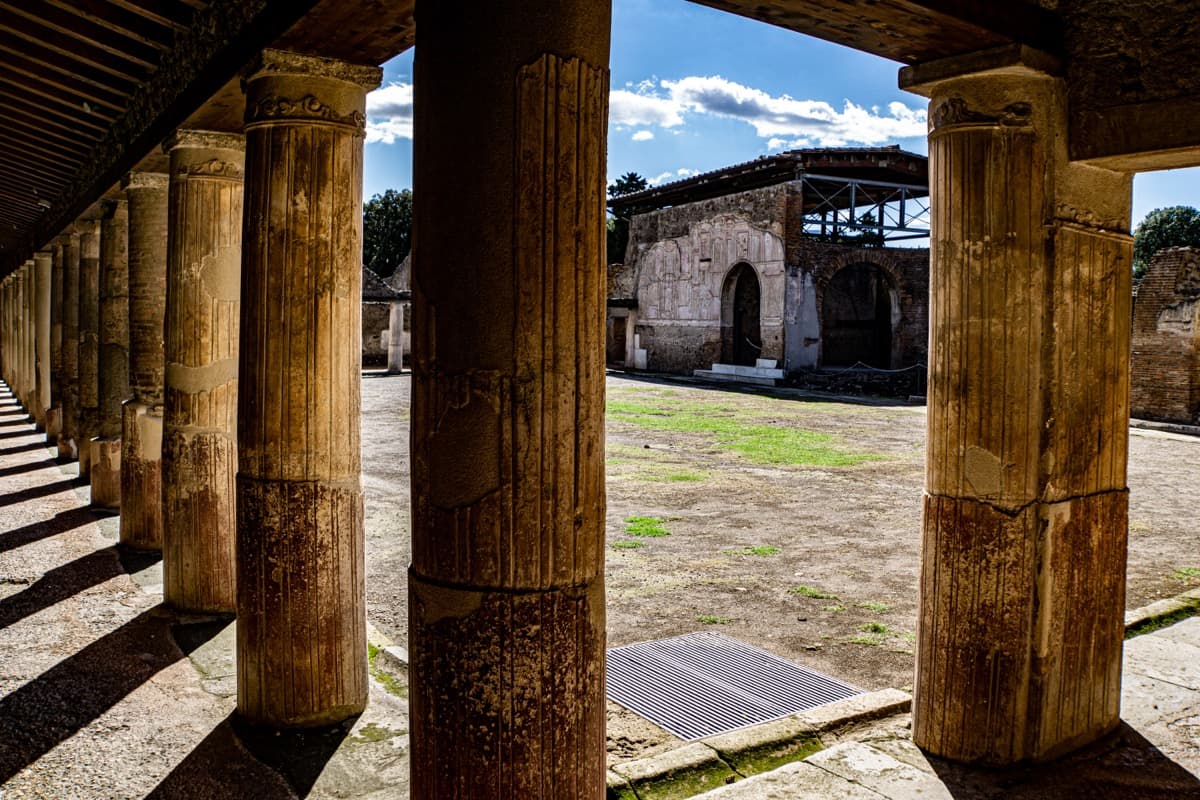
- Examine sheltered columns and entranceways: High-wear open walls have lost plaster to weather erosion, but recessed doorways, porticoes, and sheltered courtyard columns still retain legible incised lettering.
- Raking light: Morning and late-afternoon sunlight hits walls obliquely, casting small shadows across scratched lines that are invisible under direct midday sun.
What Languages Were Used in Pompeii Graffiti?
While Latin constitutes the vast majority of surviving inscriptions, Pompeii graffiti documents a multilingual Mediterranean crossroads where Latin, Greek, and Oscan coexisted in everyday speech.
- Latin (Vulgar Latin): The dominant language of everyday commerce and civic administration. The graffiti preserves invaluable evidence of phonetic shifts, dropped final consonants (such as final -m), and grammatical developments that foreshadow the evolution of Italian and the Romance languages.
- Greek: Widely spoken by merchants, enslaved individuals, freedmen, and cultured Roman elites. Greek inscriptions in Pompeii include literary fragments, quotations from Homer and Greek epigrams, love notes, and accounting tally marks.
- Oscan: The native Italic language of Campania before Roman colonization in 80 BC. Oscan survived in graffiti as trade marks, masonry stamps, personal names, and architectural notations.
- Bilingual code-switching: Several Pompeian wall inscriptions switch fluidly between Latin vocabulary and Greek script, demonstrating how multilingual residents integrated both cultures in daily communication.
What Does Pompeii Graffiti Reveal About Roman Life?
These inscriptions provide irreplaceable primary-source evidence of daily life in ancient Pompeii, illustrating literacy rates, social hierarchy, and personal relationships that traditional literary texts overlooked.
Widespread Everyday Literacy
Roman wall writings challenge the long-held assumption that literacy was restricted entirely to the aristocratic elite. In Pompeii:
- Enslaved domestic workers and shop assistants scratched names, inventory counts, and personal messages.
- Women actively left inscriptions expressing personal affection, financial loans, and trade agreements.
- Children practiced the Roman alphabet on columns at knee height, showing early foundational schooling.
Commercial Culture and Taverns
Commercial graffiti also illuminates Pompeii’s thermopolia and ancient street-food culture, detailing beverage prices, menu offerings, and tavern customer interactions:
- Bar owners tracked customer tabs and wine quality ("Here you can drink wine for 1 as; if you give 2, you will drink better; if you give 4, you will drink Falernian").
- Dice players and gamblers recorded scores and disputes in the backrooms of local taverns.
Where to See Pompeii Graffiti on a Self-Guided Visit
To explore authentic wall writings on a self-guided walk, follow this focused sequence through the archaeological park:
- The Basilica (Civic and Legal Center): Enter through the Porta Marina entrance and proceed to the Forum. The interior walls and perimeter columns of the Basilica contain hundreds of scratched personal notes, insults, and literary tags left by waiting litigants and bystanders.
- Via dell'Abbondanza (The Political Corridor): Walk eastward down Pompeii's main commercial artery. Look at the plastered facades of shops and townhouses, where painted red-and-black programmata still advertise election candidates and gladiator events.
- The Lupanar (Regio VII): Located between the Forum and the commercial district, the rooms of Pompeii's official brothel preserve more than 120 graffiti inscriptions cataloged in the Corpus Inscriptionum Latinarum (CIL IV 2173–2296), written in Latin and Greek by patrons, workers, and visitors.
- Taverns and Residences (Regio VI & House of the Vettii): Explore preserved snack counters (thermopolia) and surrounding residences, noting where customer tallies, price lists, and protective apotropaic symbols were carved into thresholds.
Combining these graffiti stops with the best places to see in Pompeii allows you to experience both grandiose civic architecture and intimate human voices on a single self-guided route.
For comprehensive site maps, historical background, and zoning analysis, consult our complete Pompeii archaeological guide before mapping your itinerary.
Explore Pompeii With an Archaeologist Guided Tour
Why Is Pompeii Graffiti Difficult to Preserve?
Ancient graffiti is among the most fragile archaeological material on site:
- Environmental exposure: Rain, atmospheric humidity, and seasonal temperature fluctuations cause external stucco to flake away, destroying shallow incisions.
- Sunlight and UV degradation: Painted dipinti fade rapidly once exposed to direct sunlight following excavation.
- Physical contact: Decades of unregulated tourist touch wore down many prominent Latin inscriptions along main avenues.
- Digital conservation solutions: Modern conservators at the Archaeological Park utilize high-resolution raking-light photography, 3D laser scanning, and non-invasive chemical consolidants to document and stabilize inscriptions before they fade.
Frequently Asked Questions About Pompeii Graffiti
What did Pompeii graffiti say?
Pompeii wall messages covered everyday subjects including romance, insults, political campaigns, business notices, jokes, and short personal remarks. They document how ordinary Roman citizens, workers, and travelers expressed themselves in public and private spaces.
What are the most famous Pompeii graffiti quotes?
Some of the best-known examples include the amphitheater inscription lamenting how many tedious writings the walls had to bear ("O walls, you have held up so much tedious graffiti..."), the love notes of Successus and Iris, and humorous boasts left by gladiators and latrine users.
Can you still see graffiti in Pompeii today?
Yes. Visitors can encounter original inscriptions in areas such as the Basilica, Via dell'Abbondanza, the Lupanar, and selected houses, although access and visibility can vary based on conservation schedules and lighting conditions.
Was Pompeii graffiti written in Latin?
Much of the surviving graffiti is written in Vulgar Latin, but inscriptions in ancient Greek and indigenous Oscan are also documented, reflecting the multilingual, cosmopolitan nature of Campania's port region.
Why is Pompeii graffiti important?
It records voices and social concerns that rarely survive in formal Roman histories, including authentic evidence of working-class literacy, slang, electoral politics, and daily interpersonal relationships prior to the AD 79 eruption.
Primary sources and epigraphic references
- Corpus Inscriptionum Latinarum (CIL IV), Inscriptiones parietariae Pompeianae Herculanenses Stabianae, ed. K. Zangemeister et al. (incorporating inscriptions CIL IV 2173–2296 from the Regio VII Lupanar).
- The Ancient Graffiti Project, directed by Dr. Rebecca Benefiel (digital epigraphic database and spatial mapping of Pompeian inscriptions).
- Archaeological Park of Pompeii Official Research & Conservation, Parco Archeologico di Pompei.
Download the Pompeii 1-Day Itinerary & Visiting Guide (PDF)
Covering 66 hectares in the heat can be exhausting. Get our printable offline guide with timed walking routes, schematic site map, must-see frescoes, fountain refill points, and skip-the-line tips.