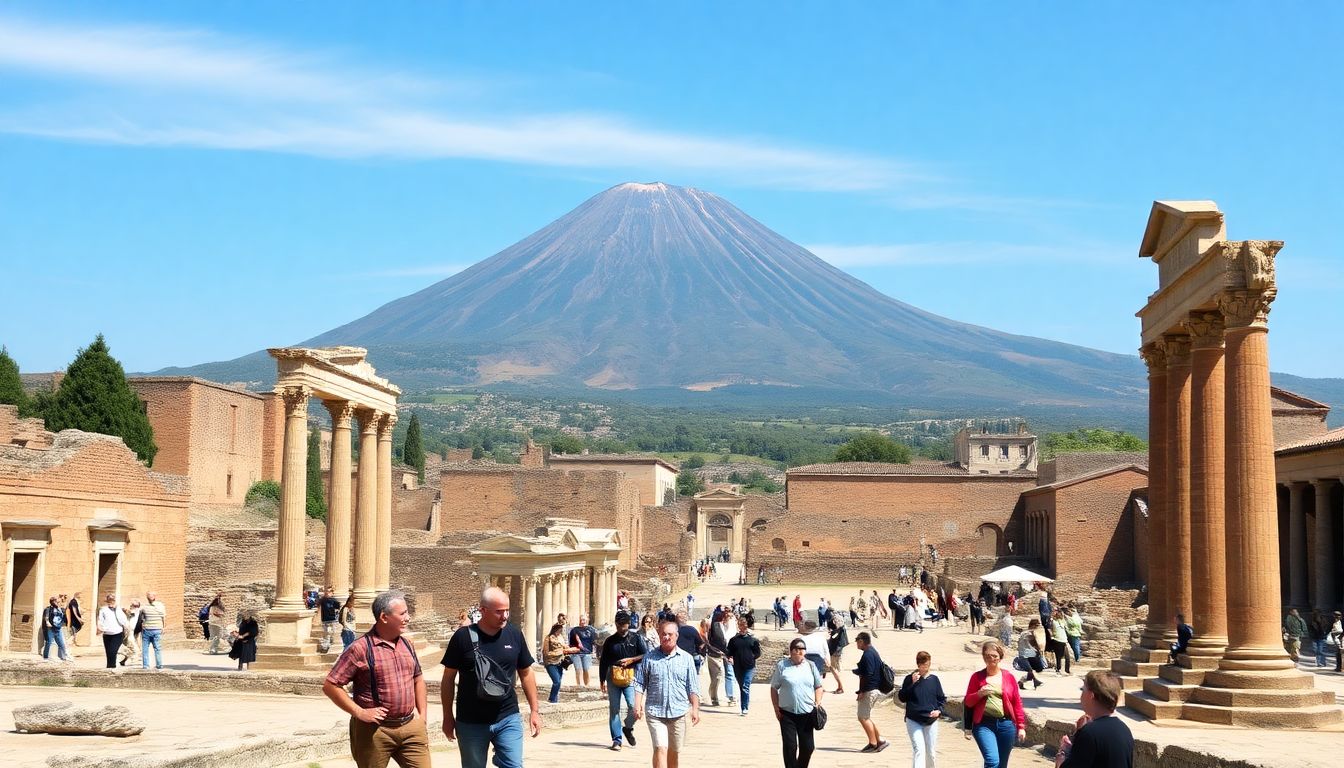
Mount Vesuvius And Pompeii One-Day Itinerary
Yep, you can totally visit both Pompeii and Mount Vesuvius in a single day. Just start early at the archaeological site, spend your morning wandering the ancient ruins, then head over to the volcano for an afternoon crater hike. Plan on about seven to eight hours from your first entry at Pompeii to when you come back down from the Vesuvius trail—not counting the time it takes to get to and from Naples, Sorrento, or Rome.
To make this work in 2026, you need to book things in the right order. Pompeii enforces strict nominative tickets, a 20,000-person daily cap, and timed entry windows during busy season. Vesuvius also asks you to reserve a time slot. If you get both tickets sorted before your trip, you’ll avoid the biggest headache and save a bunch of time.
I recommend starting with Pompeii. The morning light’s better for photos, there are fewer crowds at opening, and you dodge the worst midday heat inside the ruins. By early afternoon, head up to Vesuvius. The trail isn’t too tough, and the views over the Bay of Naples are usually clearest then.
Here’s a step-by-step plan for entry rules, transport, what to see, and when a guided tour might just save your sanity.
Key Takeaways
- You can realistically visit Pompeii and Mount Vesuvius in one day if you’re at the ruins by 9:00 AM and plan your volcano hike for early afternoon.
- Pompeii’s 2026 nominative ticket rules, daily visitor cap, and timed entry windows mean you’ll need to book ahead and bring matching photo ID.
- Deciding between going solo or booking a combined Pompeii and Vesuvius tour depends on how you feel about trains, shuttles, and managing your own time.
Can You Visit Both In One Day?
Doing both Pompeii and Mount Vesuvius in one day is definitely doable, but you’ll need to keep a tight schedule and plan ahead. The trick is getting to Pompeii early, making your transfer without delays, and climbing Vesuvius before the last entry slots close at the crater.
How Long The Full Day Usually Takes
If you focus on Pompeii’s main highlights, you’ll spend about three to four hours there. Then, add 30 to 45 minutes to get from Pompeii to the Vesuvius trailhead. The crater hike and time at the top usually take 60 to 90 minutes, plus another 30 to 45 minutes to get back down. All in, you’re looking at seven to eight hours of sightseeing and transit.
Coming from Naples? The Circumvesuviana train takes about 35 minutes each way. From Sorrento, it’s about 30 minutes. Rome’s a bit of a trek—a high-speed train to Naples takes around 70 minutes, so a round trip can easily run 12 hours door to door.
Who This Plan Works Best For
This one-day plan is best for people who don’t mind walking a few miles on uneven ground, can handle a moderate uphill hike, and want to pack a lot into a single day. It’s great for active adults, older teens, or anyone with only one day in Campania.
If you want to see every inch of Pompeii, have mobility issues, or are traveling with little kids who need lots of breaks, this plan might feel rushed.
When A Combined Tour Makes More Sense
A combined Pompeii and Vesuvius tour takes away the stress of figuring out shuttles and train times. If you’re coming from Rome or just don’t want to juggle separate tickets and midday transport, an organized tour handles all the details.
Companies like GetYourGuide, Viator, and Walks of Italy usually include skip-the-line entry, a guide at Pompeii, and a shuttle to Vesuvius. If you’re short on time or traveling with a group, this can be a real lifesaver.
Book Before You Go: 2026 Rules And Entry Planning
For 2026, the big change is that both Pompeii and Mount Vesuvius require advance ticket purchases with specific time slots. If you show up without a reservation, especially from April through October, you might get turned away.
Pompeii Nominative Tickets And Photo ID Requirements
Every Pompeii ticket in 2026 is nominative—it’s tied to your name when you buy it, and you can’t change the name later. At the entrance, staff check your ticket against a government photo ID, like your passport or driver’s license.
Bring the same ID you used to book. If the names don’t match, they won’t let you in. This rule applies to everyone, even kids who need a free reservation.
Daily Visitor Cap And Timed Entry At Pompeii
Pompeii now limits daily visitors to 20,000. During peak season, tickets have timed entry blocks, so your ticket tells you when you need to arrive.
Book the earliest slot you can—ideally 9:00 AM. That way, you get the whole morning to explore before heading to Vesuvius. Standard adult tickets run about €18 to €20, with discounts for EU visitors 18-25 and free entry for under-18s.
How To Time Vesuvius Tickets After Pompeii
Vesuvius tickets also come with set time slots. If you plan to leave Pompeii around 12:30 or 1:00 PM, book your Vesuvius crater entry for 2:00 to 2:30 PM. That gives you time to get there and a little wiggle room if you run late.
Afternoon slots at Vesuvius can sell out, especially on weekends or holidays. Buy your volcano ticket when you book Pompeii—don’t wait until the last minute.
Official And Partner Booking Options
Buy official Pompeii tickets through VivaTicket at pompeiisites.org. For Vesuvius, the Mount Vesuvius National Park website handles crater access reservations.
Authorized partners like GetYourGuide, Viator, and Tiqets offer combo tickets and guided tours that bundle both sites. These often include transport, which makes everything easier. PompeiiItaly.org keeps an updated list of trusted booking links if you want to compare. Always double-check prices and policies on the official sites before you buy.
Morning Plan For Exploring Pompeii
Your morning at Pompeii usually means three to four hours of walking through a city frozen in time since 79 AD. Try to get there early, follow a route that hits the highlights, and save some energy for the afternoon hike.
Best Arrival Time And Entrance Choice
Get to the Porta Marina entrance by 8:45 AM, about 15 minutes before the usual 9:00 AM opening. On summer weekends, gates sometimes open at 8:30 AM, which is even better.
Porta Marina sits closest to the Circumvesuviana train station (Pompei Scavi, Villa dei Misteri) and puts you near major attractions right away. Piazza Anfiteatro and Piazza Esedra are other options, but Porta Marina is the most efficient for a quick visit.
What To See In Three To Four Hours
Stick to a loop that covers the essentials without doubling back.
- The Forum: Pompeii’s main square, surrounded by temples and public buildings
- Temple of Apollo: one of the city’s oldest religious sites
- House of the Faun: famous for its Alexander mosaic
- House of the Vettii: packed with frescoes of Roman life and myth
- Stabian Baths: the oldest public baths, with well-preserved heated rooms
- Lupanar: the city’s main brothel, with risqué wall art
- Large Theater: a 5,000-seat venue built right into the hillside
- Garden of the Fugitives: plaster casts of victims from the eruption
- Via dell'Abbondanza: main street, lined with shops and snack bars
If you have extra time, check out the Villa of the Mysteries near Porta Marina. Its wall art is honestly some of the best you’ll see from ancient Rome.
How Pompeii Connects To The 79 AD Eruption
Everything in Pompeii survived because Mount Vesuvius buried the city under about 19 feet of ash and pumice in August of 79 AD. Pyroclastic flows—basically avalanches of superheated gas and rock—raced down the volcano, reaching 500 to 900 degrees Fahrenheit and speeds up to 180 mph.
The Romans in Pompeii didn’t realize Vesuvius was an active volcano. Earthquakes in the years before, including a big one in 62 AD, were warning signs that most people ignored. Herculaneum, nearby, got hit even worse—buried under an even thicker blanket of volcanic debris.
Pompeii was a busy trade city of 12,000 to 15,000 people, with Venus as its patron goddess. The ash preserved everything from bread in ovens to graffiti on walls, offering an incredible peek into Roman daily life.
Where To Take A Break Before Heading Uphill
Before you leave Pompeii, grab a bite at one of the cafes or snack bars near the entrances in modern Pompei town. There’s a small refreshment stand inside the park by the Forum, but options are pretty limited.
Honestly, eat a real lunch outside the gates—you’ll need the energy for the Vesuvius hike. Restaurants along Via Plinio and near the Pompei Scavi train station serve quick meals. Definitely fill up your water bottle; there are no vendors on the crater trail until you reach the top.
Getting From Pompeii To The Crater Trail
The midday transfer is where you really need to plan ahead. There are a few options, each with its own pros and cons for cost, convenience, and flexibility.
Using The Circumvesuviana Train
Hop on the Circumvesuviana train from Pompei Scavi toward Ercolano Scavi, which is the closest stop to the Vesuvius access road. The ride takes about 20 minutes and costs around €2.80.
From Ercolano Scavi station, you’re still at the base of the mountain. The crater trailhead sits at about 1,000 meters up, so you’ll need to catch a shuttle bus or arrange private transport to the parking area at the top.
Shuttle And Bus Options To The Volcano
EAV buses run between Pompeii and the Vesuvius crater parking area. Service frequency changes with the season, but in the busy months, you’ll usually see a bus about every 50 minutes. Always double-check the latest schedule—sometimes things change last minute.
From Ercolano Scavi, local shuttle buses show up more often, typically every 20 to 30 minutes. The ride from Ercolano up to the trailhead takes about 25 to 30 minutes, and the road winds a lot. Expect to pay €8 to €10 for a round-trip ticket.
Vesuvio Express And Other Transfer Choices
The Vesuvio Express is a private shuttle that leaves from Ercolano Scavi station and drops you right at the crater entrance. It sticks to a regular timetable during visiting hours and is honestly one of the most dependable options if you’re traveling on your own.
You’ll also find other private transfers and taxis at both Pompeii and Ercolano. A taxi from Pompei to the Mt. Vesuvius parking area costs more—think €40 to €60 one way. But if you’re in a group that can split the fare, it’s a real time-saver.
Independent Travel Versus Organized Transport
If you’re comfortable figuring out Italian transit and don’t mind a bit of waiting, going independently costs less. You’ll probably spend around €15 to €20 per person for the full round trip from Pompeii to the crater using trains and shuttles.
Organized tours take out all the guesswork. These tours often bundle a private bus or van that brings your group from the ruins to the volcano—no switching at stations. If your Vesuvius entry time is tight, or if you’re traveling with folks who just want things simple, paying extra for a tour really cuts down on stress.
Afternoon Hike On Mount Vesuvius
After a morning wandering ancient streets, the Vesuvius crater trail feels like a reward. The hike isn’t long, the views are wild, and honestly, standing above one of Earth’s most famous volcanoes is an experience you’ll remember.
What The Walk To The Crater Is Really Like
The trail from the parking lot up to the crater rim is about a kilometer, and you’ll climb roughly 200 meters. The path is made of packed gravel and volcanic rock, and some parts get pretty steep—loose stones can make things slippery. Metal railings help out on the toughest stretches.
Most people finish the hike in 25 to 35 minutes at a steady pace. It’s not technical, just a steady uphill slog, and the uneven ground will remind you of your morning at Pompeii. Up top, a short loop lets you walk along the rim and look straight into the crater.
Weather, Clothing, And Trail Preparation
The weather on Vesuvius often surprises people. It’s usually 5 to 10 degrees Celsius cooler at the summit than in Pompeii. Wind whips around the crater rim, and clouds can show up fast even on days that start out clear.
Wear sturdy, closed-toe shoes with good grip. Sneakers are fine for most, but skip sandals or dress shoes—the gravel is unforgiving. Bring a light jacket or windbreaker, even in summer. Sunscreen, sunglasses, and a hat matter, too, since there’s almost no shade on the trail.
Carry at least a liter of water per person. There’s a little refreshment stand near the crater entrance, but prices are high compared to the base.
Views Over The Bay Of Naples
If you get a clear afternoon, the view from the rim is unreal. You’ll see Naples spread out to the north, the Sorrento Peninsula curving off to the south, and Capri floating in the distance.
Look inland and you’ll spot towns scattered across Vesuvius’s lower slopes. It’s a pretty wild reminder that this volcano threatens about three million people. The contrast between the gorgeous views and the underlying risk is both peaceful and a little unsettling.
How Much Time To Spend At The Top
Set aside 60 to 90 minutes for the whole round trip from the parking area up to the crater and back down. You’ll want 20 to 30 minutes at the top to walk the loop, snap some photos, and just take it all in.
If you booked a late time slot, watch your return schedule. The last shuttles and buses down the mountain leave at set times, and missing them means you’ll have to call a pricey taxi. Check the departure board at the parking lot before you start your climb.
History, Geology, And Safety Context
Mount Vesuvius and the ruins of Pompeii together make up one of the world’s most fascinating spots for volcanology, archaeology, and disaster science. The way the volcano’s history and the preserved city fit together gives you a real sense of what an eruption can do—and why scientists keep such a close eye on active volcanoes today.
Why Vesuvius Is One Of The Most Studied Volcanoes
Vesuvius stands as the only active volcano on mainland Europe. It’s erupted dozens of times since 79 AD, with the last one in 1944. It sits in the Campania volcanic arc, a region shaped by the African plate pushing under the Eurasian plate.
Scientists have watched Vesuvius for centuries. The Vesuvius Observatory, founded way back in 1841, is actually one of the oldest volcano research centers anywhere. They use seismic sensors, gas monitors, and ground movement trackers to keep tabs on risk. This research helps people all over the world understand and prepare for volcanic hazards—not just Italians.
The 79 AD Eruption And Earlier Warning Signs
Looking back, the 79 AD eruption didn’t come out of nowhere. A big earthquake hit the area in 62 AD, damaging buildings in Pompeii and Herculaneum. In the weeks before the eruption, smaller quakes rattled the ground, and wells and springs dried up as magma built pressure underground.
When Vesuvius finally blew in August 79 AD, it shot a column of ash and pumice about 21 miles high. The eruption lasted more than a day. Some Pompeii residents escaped during the first ashfall, but around 2,000 people who stayed behind died when the eruption turned deadly.
Earthquakes, Ash, And Pyroclastic Surges Explained
The most dangerous part of the eruption wasn’t falling ash or rocks—it was the pyroclastic flows. These are blazing fast currents of superheated gas, ash, and rock that barrel down the volcano at up to 180 miles per hour, with temperatures from 500 to 900 degrees Fahrenheit.
Vesuvius sent out as many as six pyroclastic surges during the 79 AD eruption. The early ones wiped out Herculaneum, which sat closer to the volcano. Later surges reached Pompeii, five miles away, killing anyone left behind. Volcanic ash buried Pompeii under nearly 20 feet, preserving buildings, objects, and even people’s shapes for almost two thousand years.
Pompeii, Herculaneum, And The Landscape Today
Pompeii and Herculaneum were both Roman cities destroyed by the same eruption, but they’re preserved in different ways. Ashfall and pumice buried Pompeii. Herculaneum got hit by pyroclastic flows, which left a thicker, harder layer and preserved things like wood and food even better.
These days, the area around Vesuvius is packed with people. The volcano’s rich soil supports farms, and the modern town of Pompei sits right next to the ruins. Mount Vesuvius National Park protects the upper slopes and crater, keeping up the trails and the wild landscapes that have grown back over the years. The mix of geology, nature, and history here is honestly pretty unique.
Frequently Asked Questions
What happened during the AD 79 eruption that buried Pompeii?
Mount Vesuvius erupted in August 79 AD, blasting a huge column of ash and pumice over 21 miles into the sky. Over about 24 hours, the eruption shifted from heavy ashfall to deadly pyroclastic flows that buried Pompeii under almost 20 feet of volcanic debris, killing an estimated 2,000 people in the city.
How did the eruption affect daily life and the people of Pompeii and Herculaneum?
The eruption froze both cities in the middle of everyday Roman life. Archaeologists found bread still in ovens, meals on tables, and graffiti on the walls. Pyroclastic surges hit Herculaneum first, while Pompeii got hours of ash before the final deadly flows arrived. Some residents escaped, but those who stayed were trapped.
What are the key facts and timelines to know about the history of the site before and after the eruption?
Pompeii started around the 7th century BC and grew into a lively Roman city of 12,000 to 15,000 people by 79 AD. A big earthquake struck in 62 AD, and the city was still rebuilding when Vesuvius erupted 17 years later. Rediscovered in 1748, the site has been under excavation ever since and now stands as a UNESCO World Heritage site.
What should visitors expect in terms of hiking difficulty, entry tickets, and logistics when visiting the crater?
The crater trail stretches for about 1 kilometer and heads uphill almost the whole way. Most people finish the hike in about 25 to 35 minutes, though honestly, it depends on your pace and how often you stop to catch your breath or snap a photo.
You’ll need to book a timed entry ticket ahead of time. These slots can disappear pretty fast, especially later in the day, so don’t wait till the last minute.
Definitely wear sturdy shoes and bring some water. A light jacket isn’t a bad idea either, since the weather can surprise you.
Give yourself 60 to 90 minutes for the round trip, including time to hang out at the rim and take in the view.